Service Upgrades
Forensic Breakdown: The Anatomy of a Lamp Failure
Back to Articles Back to all articles
"Is that flickering lamp a simple bulb change or a sign of a deteriorating circuit?"
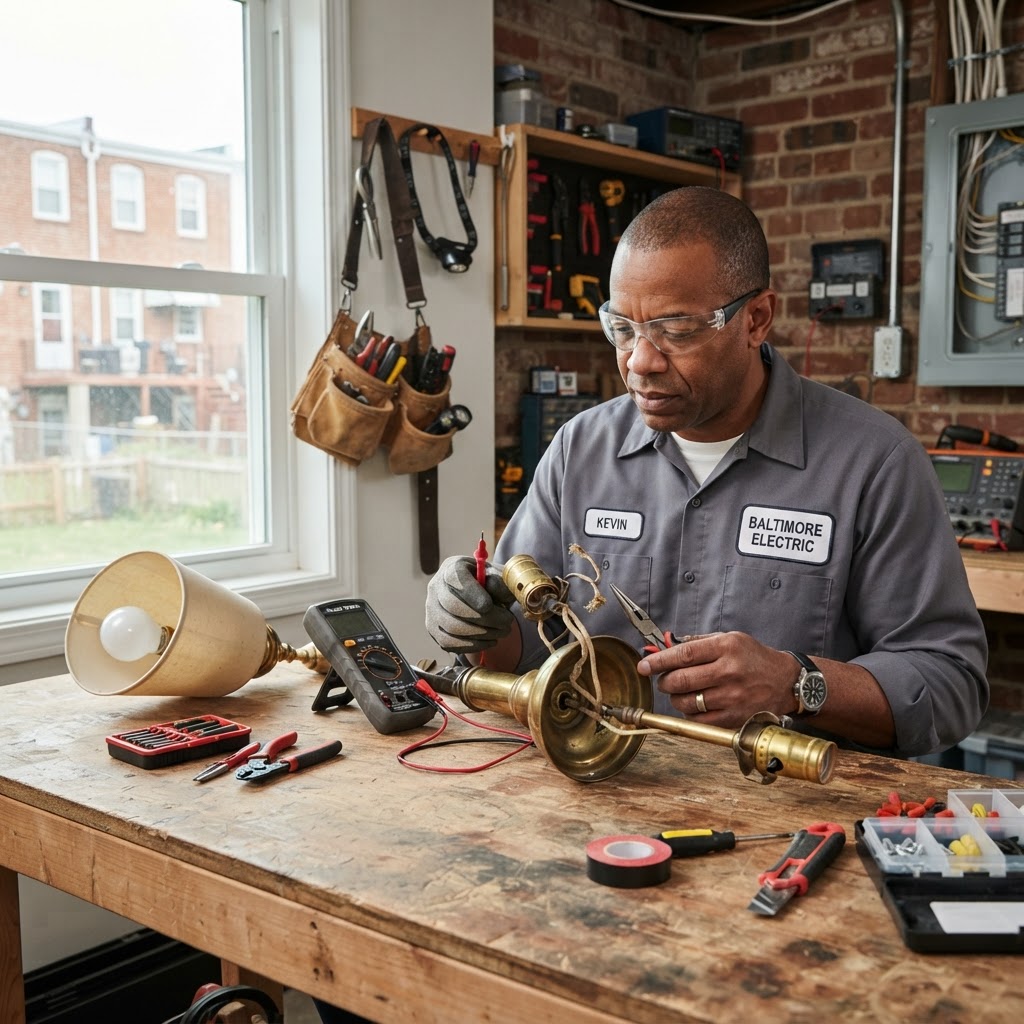
When a lamp fails in a Baltimore home, the issue rarely lies in the fixture itself but rather in the degradation of its internal delivery systems. In Baltimore City, while basic maintenance like changing a bulb is standard, any alteration to the internal wiring or socket mechanisms of a vintage lamp constitutes an electrical intervention that should be handled with professional scrutiny. Most lamp failures we diagnose stem from thermal fatigue, where repeated heating cycles have rendered insulation brittle, or from socket corrosion caused by years of exposure in humid Maryland basements and attics.
THE FAILURE MECHANISM
We often encounter what we categorize as a field-expedient fix—someone attempting to repair a socket with electrical tape or mismatched wire nuts. This acts as a cognitive bypass, ignoring the fundamental need for proper polarization and heat dissipation. When a lamp is wired incorrectly, it becomes an as-built anomaly, creating a hazard where the metal exterior of the lamp could become energized. If you are dealing with a recurring short or a plug that runs hot to the touch, you are witnessing the early stages of a potential arc-fault event.
NAVIGATING LOCAL CODES
It is critical to distinguish between simple appliance maintenance and electrical system alteration. While Baltimore County allows for routine maintenance, Baltimore City codes, governed by the IRC and local building amendments, are strict regarding the integrity of electrical devices. If the lamp repair requires replacing internal switches or re-wiring the cord, it must comply with modern safety standards. Attempting to bypass these requirements is a dark pattern that frequently leads to ungrounded systems and fire risks.
PRACTICAL DIAGNOSTICS
Before deciding on a repair, inspect the cord for signs of cracking or 'legacy spec' insulation that has lost its elasticity. If the lamp is a cherished antique, we can often facilitate a professional retrofit that maintains the aesthetic while ensuring the guts meet current safety protocols. Avoid the temptation to use high-wattage LED retrofits in sockets designed for higher thermal loads if the internal wiring is compromised, as this can exacerbate hidden damage. Related reading: Residential Electrical Services.
RELATED QUESTIONS
Q: Does a lamp repair require a permit in Baltimore? A: Simple bulb replacements do not, but internal wiring repairs or fixture modifications in the city may require professional assessment to ensure code compliance. Q: Can I just replace the plug myself? A: While possible, improper installation often leads to arcing. We recommend a safety inspection of the entire fixture if the cord has been compromised. Q: Why does my lamp flicker? A: It is usually a loose connection or a worn socket contact, both of which indicate mechanical fatigue that a standard bulb change cannot solve.
Published 2026-10-02
Sources
Take Action: For professional diagnostic services for your home’s electrical fixtures, contact Charm City Electric at CharmCityElectric.com or (443) 469-9371.
Call (443) 469-9371