Historic Homes
Material Forensics: The Aluminum Branch Circuit Hazard
Back to Articles Back to all articles
"Is your Baltimore rowhome hiding a conductive ticking time bomb behind its plaster walls?"
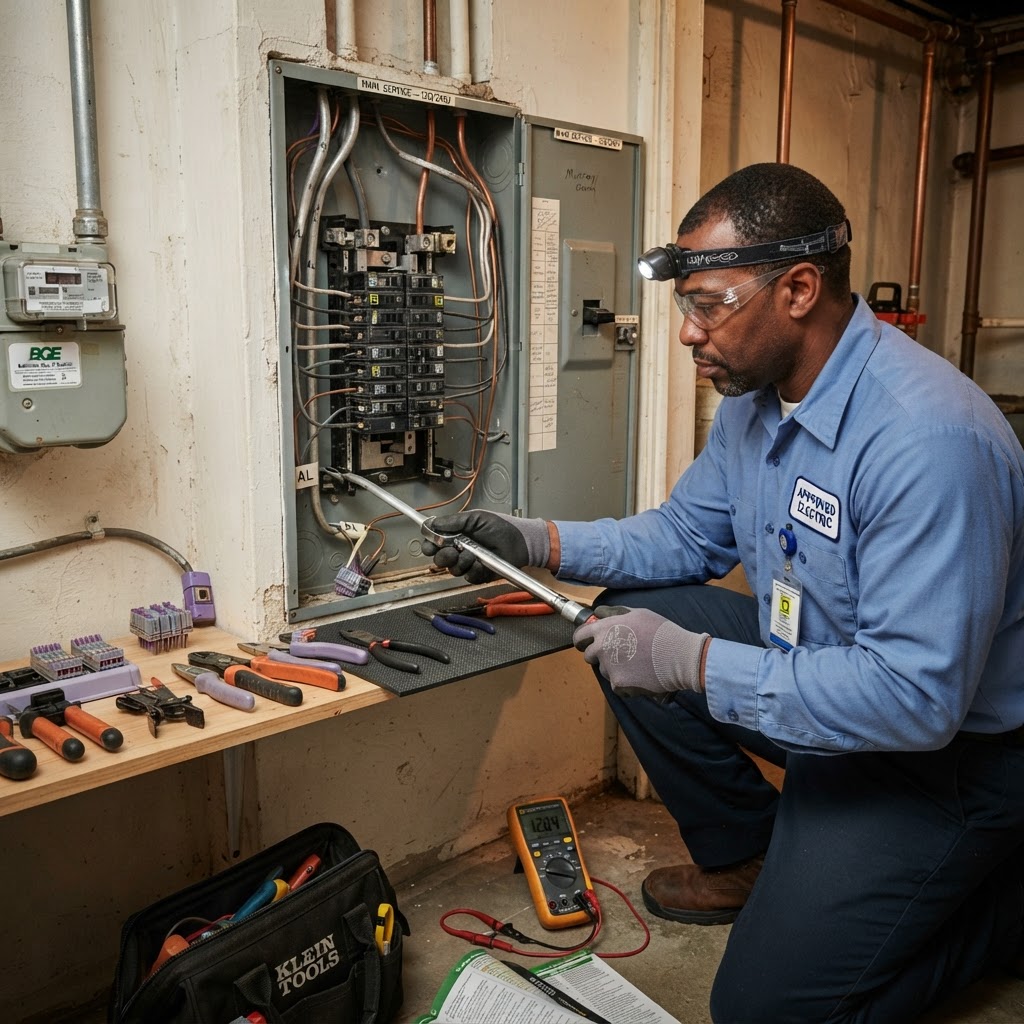
The primary mechanism of failure in residential aluminum branch circuit wiring is thermal expansion and contraction, which eventually leads to high-resistance connections and potential arc faults. Unlike copper, aluminum wire oxidizes quickly, and its coefficient of expansion causes connections at outlets and switches to loosen over time. This creates a feedback loop of heating and cooling that can compromise the termination point, eventually leading to terminal failure. For Baltimore homes built between the mid-1960s and early 1970s, the only permanent forensic solution is a total system re-wire with copper or the professional installation of CPSC-approved interface connectors like AlumiConn or the COPALUM crimp system.
IDENTIFYING THE ANOMALY
Many older homes in neighborhoods like Mount Vernon or Roland Park still house these legacy specs. We often uncover these during a routine safety inspection, where the homeowner reports flickering lights or warm switch plates. These are not merely quirks; they are the early indicators of a structural failure. Treating these as a nuisance is a cognitive bypass of the physics at play; the oxidation at the junction creates a localized hot spot that does not trip a standard breaker until significant degradation—or combustion—has occurred.
THE FIELD-EXPEDIENT TRAP
We frequently encounter dark patterns in the form of DIY repairs where a previous owner attempted a field-expedient fix using standard wire nuts not rated for aluminum. This is a catastrophic miscalculation. Standard copper-rated connectors do not compensate for aluminum’s unique thermal properties, often accelerating the failure process. An unwritten protocol of our trade is that if you find aluminum wiring, it must be evaluated by a professional who understands the specific expansion rates and mechanical integrity of the required interface connectors.
NAVIGATING COMPLIANCE
Baltimore City building codes mandate strict adherence to safety standards, and modifying branch circuits often triggers requirements for updated AFCI protection. Attempting to mix incompatible metals or connectors is an inspector blind spot that can lead to failed sales or, worse, insurance claim denials. If you suspect your home is operating on this older infrastructure, don't rely on guesswork. We recommend reviewing our Residential Electrical Services page for more on how we assess these conditions.
RELATED QUESTIONS
Q: Is it safe to leave aluminum wiring if I haven't had issues? A: While you may not see symptoms yet, the degradation is often hidden. A professional inspection is required to determine the current state of your terminations. Q: Can I just replace the light switches myself? A: No. Aluminum wiring requires specialized, UL-listed connectors. Using standard hardware can create a fire hazard.
Published 2026-09-28
Sources
Take Action: For a professional assessment of your wiring integrity, contact Charm City Electric at (443) 469-9371 or visit CharmCityElectric.com.
Call (443) 469-9371